Thursday, December 5, 2024

Medievalism in Star Wars


🟎Medievalism in George Lucas's Star Wars🟎


🟎🟎🟎🟎🟎🟎🟎🟎
    Star Wars is a widely known pop-culture phenomenon, spanning over years and years of time since it was first seen on the big screen. It is nearly impossible to describe the plot of this legacy, as it has a multitude of platforms, from the original trilogy to different scattered branch-off series. However, medievalism can be seen throughout the course of Star Wars' legacy through costume designs, "(Jedi) knights and their 'swords,' and even their code of conduct"  (1).
🟎🟎🟎🟎🟎🟎🟎🟎

Wednesday, December 4, 2024

The Princess Bride (1987) Through a Medieval Lens


Figure 1 "Westley & Buttercup"

Summary

The 1987 film, "The Princess Bride," is a fairytale revolving around the main characters' love story. Essentially, main characters, Buttercup and Westley, fall madly in love before Westley leaves in order to become wealthy with the intention to return and marry his love. Things go very wrong for both Westley and Buttercup, as his ship gets captured and she gets kidnapped. The fairytale then follows Westley's quest to save his love, Buttercup, encountering many stumbling blocks along the way. Though the medievalism within the film can often be overlooked, as it is not necessarily obvious, medieval features are sprinkled throughout nonetheless. 


Quest & Adventure

One of the largest aspects or plots of "The Princess Bride" is Westley's quest to rescue Buttercup after she is kidnapped. A quest is a reoccurring theme seen in medieval literature, often accompanied with knights as the heroes, as seen in this particular film. During his adventure, Westley does not have easy success, constantly hitting obstacles and encountering new characters, such as a thief. These obstacles and drawbacks are essentially physical and moral tests that Westley has to overcome, something that can be seen in traditional stories of the medieval time period. 


Knights & Sword Fights

Westley, among others in the film, are knight-like characters. They embody the chivalry of knights from medieval times and literature. In particular, Westley is brave and committed to saving his love, both traits of a true knight. Further, sword fights, or duels, can also be seen, most notably between Westley and Inigo Montoya. Sword fights and duels are deeply rooted in medieval literature, especially when there is a quest and/or knights involved. In medieval literature, knights can usually be seen settling their arguments and issues by battling it out in a duel, something that is no doubt portrayed in "The Princess Bride." 

Figure 2 "Westley in a Sword Fight"

In medievalism, knights are consistently characterized by their chivalry, a code that is expected by a knight. Knights should be courageous, courteous, and honorable. All of these traits can be seen in Westley's character, as he is devoted to saving Buttercup, doing anything and everything he can to get to her, no matter how challenging. Westley represents knighthood exceptionally well. 


Works Cited

"Westley & Buttercup." Entertainment Weekly. Accessed 4 December 2024.
https://ew.com/article/2014/10/03/13-things-cary-elwes-revealed-about-the-princess-bride-in-his-reddit-ama/
"Westley in a Sword Fight." Reactor. Accessed 4 December 2024. https://reactormag.com/this-is-why-we-cant-have-nice-things-moral-ambiguity-young-adult-lit-and-the-princess-bride/

Medievalism in the original 1998 TV show, Charmed

 Overview of the 1998 Charmed

Charmed, 1998 (3)

    Blending family drama, fantasy, and the supernatural, the original TV show, Charmed, follows the Halliwell sisters as they discover that they are good witches destined to fight evil. While navigating their regular human lives in San Francisco, Piper Halliwell (played by Holly Marie Combs), Phoebe Halliwell (played by Alyssa Milano), and Prue Halliwell (played by Shannon Doherty) must each keep their unique abilities a secret from the outside world as they grow into their legacy as The Charmed Ones. Although the show takes place in a modern setting, the elements of witchcraft that are practiced by the three sisters, as well as the codes they and many other supernatural characters follow in the world of magic, can be connected to medievalism in subtle ways. 

Good Versus Evil


    In the show, the Halliwell trio is constantly pitted against the forces of evil, be it warlocks, demons, or other supernatural creatures. In the medieval period, the nature of good versus evil was a constant theme represented by the culture, religion, and literature of that time. Similarly, in Charmed, the Halliwell sisters represent the forces of good protecting the innocent from the forces of evil. Their struggle also reflects the medieval view that the world is a battlefield between light and darkness. In the show, a theme of light versus darkness is constant because, with every good or light being, there is an evil or dark counterpart. For example, there are “whitelighters” and “darklighters.” Another example is, in the episode, “The Power of Four,” Phoebe and Piper meet their doppelgangers from another universe who are evil witches, contrasting with their good nature. 


The Book of Shadows 


Gerald Gardner's Book of Shadows (4)
    In the show, the sisters constantly reference the Book of Shadows as a resource of vanquishing spells, potion recipes, and catalogued history of their powerful family line. Although a real Book of Shadows has Wiccan origins and was produced in the 1950s by the “Father of Wicca,” Gerald Gardner (2), the show uses illuminated manuscripts, colorful calligraphy, and Latin text similar to the medieval period to design the Halliwells’ iconic Book of Shadows.

"The Book of Shadows," Charmed (5)

Bound in green leather with the Charmed trifecta symbolizing “The Power of Three” on its cover, the book is a constant companion to the three sisters and is considered the most powerful object in the Charmed universe. In addition, the Book of Shadows is constantly passed down through generations of the matrilineal line, with personalized additions made by significant family members, all of which are female witches. In a way, connections can be made between The Book of Shadows and a medieval “Book of Hours,” a personalized religious prayer book that could be passed down between the women of the family. 


Visions


    Each Halliwell sister has a unique ability as witches. Of the three, Phoebe Halliwell has the ability of premonition—she can see quick glimpses of the future as long as she is touching an object. Later in the show, as she develops her skills as witch and gains more knowledge and experience, her power expands so she can see the future without the assistance of objects. Her ability to see visions of the future can be connected to the ability for women to experience visions as anchorites, although Phoebe does not partake in the full practice of isolating herself in order to experience the full body visions. 


Whitelighters 


    In the show, whitelighters are guardian angels charged with protecting the witches. The Halliwell sisters’ whitelighter, Leo Wyatt (played by Brian Krause), offers the sisters divine knowledge and heals them whenever they are injured. Because of a whitelighter’s extreme devotion to the witches he or she is assigned to, a whitelighter’s code of protection, honor, and loyalty can be compared to a knight’s chivalric code to the noblewomen of the medieval period. In addition, Leo Wyatt falls in love with one of the sisters, Piper Halliwell, which is strictly forbidden by the council. However, their dynamic invites elements of courtly love into the show, pitting it against the whitelighter’s “code of chivalry” that would otherwise make their relationship impossible to pursue. 


Works Cited


1. Burge, Constance M., creator. Charmed. Spelling Television, 1998.
2. Tappenden, Roz. “Gerald Gardner: Legacy of the ‘Father of Witchcraft.’” BBC News, 13 June 2014, www.bbc.com/news/uk-england-27782244.
3. “Charmed.” IMBd, December 3, 2024, https://www.imdb.com/title/tt0158552/.
4. Belham-Payne, John. “Gerald Gardner's Book of Shadows.” BBC, https://www.bbc.com/news/uk-england-27782244
5. “The Book of Shadows.” The Charmed Legacy Wiki, https://charmedlegacy.fandom.com/wiki/Executioner_Demons


CHAPPELL ROAN:

MIDWEST PRINCESS OR MEDIEVAL ICON?


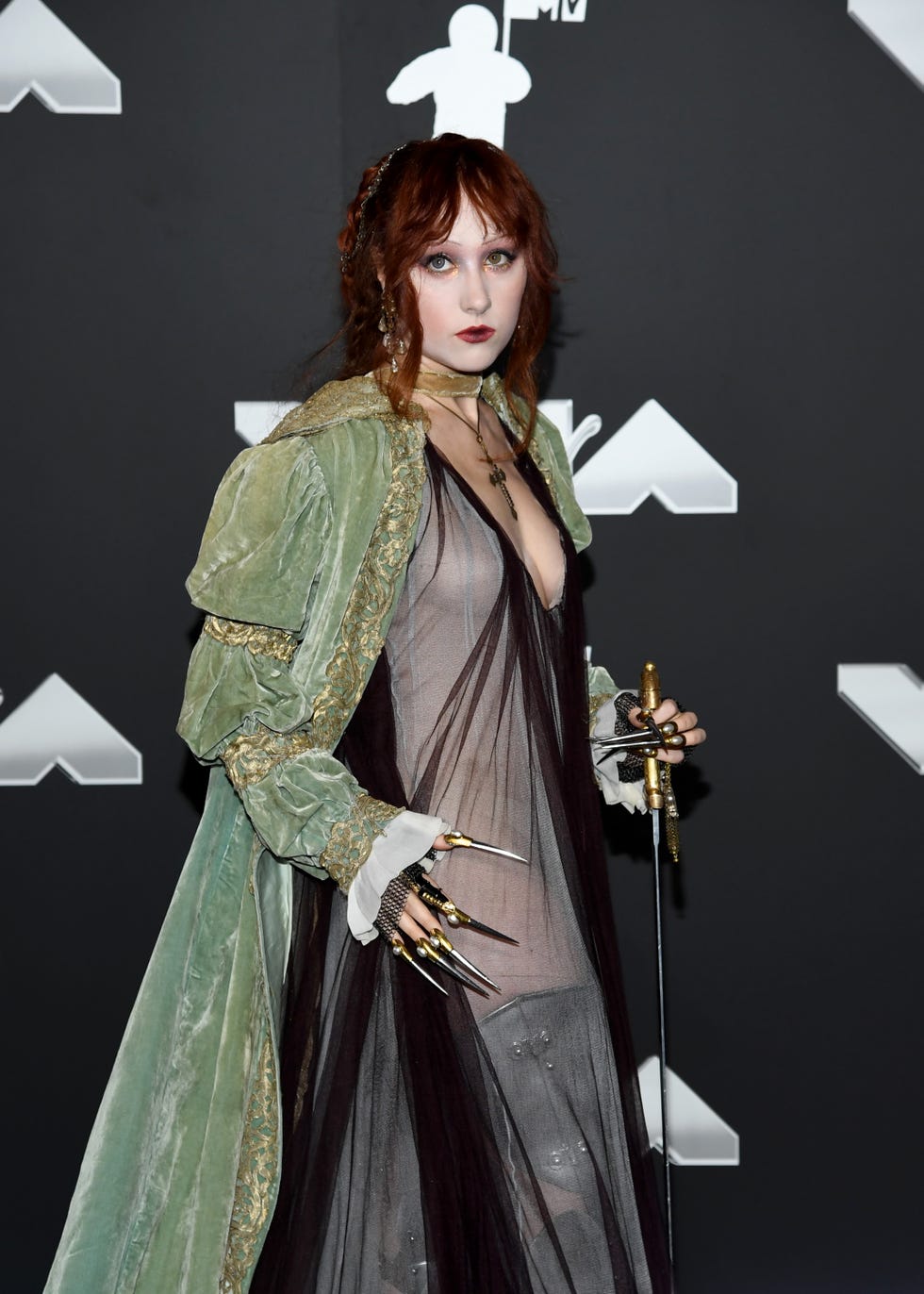
Roan at the 2024 VMAs (Bazaar)
    Drag, queerness, gender expression, and a flamboyant stage presence. These aren't likely the first things that come to mind when thinking about the Medieval Era, but pop singer Chappell Roan created the perfect overlap of the concepts with her fashion and performance at the 2024 MTV Video Music Awards.

    Roan was nominated for her first VMAs in 2024, receiving a nomination for Best Trending Video, Push Performance of the Year, and Song of Summer, along with a win in the Best New Artist category (1). Her attendance at the event culminated in her performance of her hit song "Good Luck, Babe!" The song, aimed toward a love interest forcing herself into a heteronormative life, certainly doesn't scream "Medieval." However, Roan and her designers utilized medievalism to reference key parts of the Middle Ages in a way that makes the performance stick with viewers.


The Costumes

    Roan sported three major medieval-inspired outfits at the VMAs. The first, as seen above, consisted of a dark, sheer dress with accessories that allude to chain mail, as seen in her cuffs and nails, and religious imagery, as seen in the cross on her necklace. Her costume also displayed a green cloak to frame the dress and a sword by her side. While far more revealing and modernized than typical medieval clothing, the velvety, rich appearance of the cloak contrasted with the dark, brooding look of the dress and accessories covers a wide range of medieval life, from nobility to knighthood.

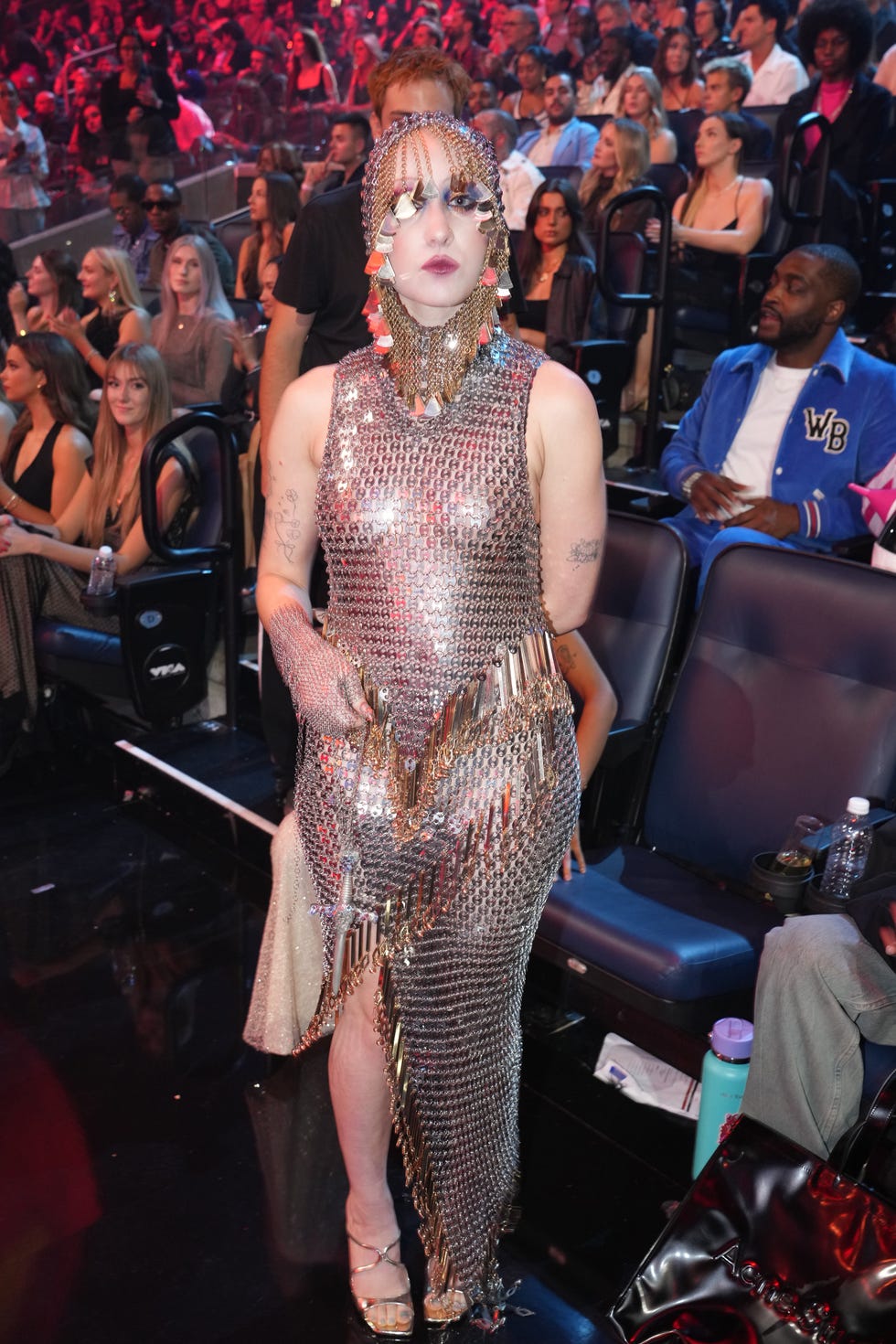
Roan's acceptance outfit (Bazaar)
    Upon acceptance of her award for Best New Artist, Roan was seen wearing a new head-to-toe outfit of chain mail with a small cross at her side. This outfit, once again, combines aspects of both medieval royalty and knighthood while playing with gender in the process. The traditionally masculine chain mail has become an outlet for the feminine outline of Roan's dress, turning a factor of fighting and warfare into a statement of beauty.

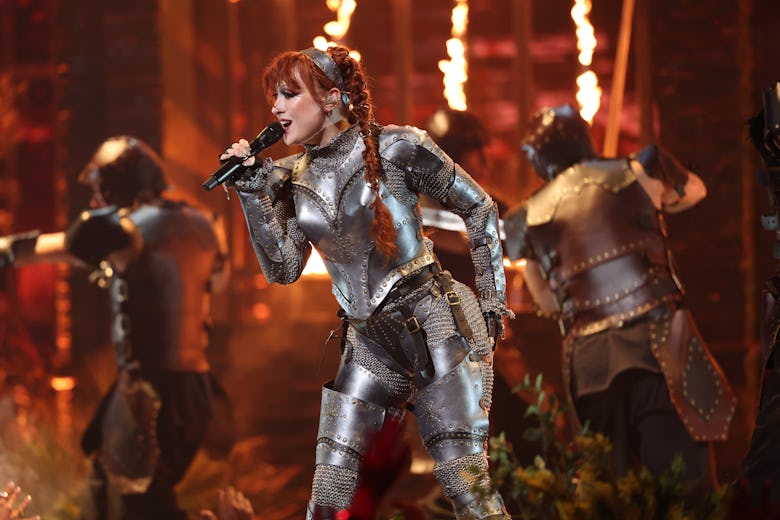
    Her third costume of the night, a shiny suit of armor, was for her stage performance at the event. The armor is more rugged than the sheer dress in which Roan started, and it serves as a finale to her expression of both medievalism and gender at the event. The frills and figure of her previous outfits are traded for a tough armor suit, which pairs well with the message of her performance.

Roan's performance costume (W Magazine)


The Performance

    Leading up to her performance, Roan simply told her stylist Genesis Webb that she wanted to do "knight" (2). Building on that, the performance of "Good Luck, Babe!" opens with an armor-clad Roan shooting a flaming crossbow arrow at a castle. The fiery castle serves as a background to her performance as Roan commands dancing knights around her. While some struggle to see the correlation between the song and the performance, many see inspiration taken from the medieval history of Joan of Arc. Patron saint Joan of Arc is best known for her leadership in war while assuming the appearance and traits common for men at the time (3). With the background we have about Roan's exploration with medievalism, war, and gender throughout her costumes, its no surprise that her ultimate performance is inspired by the tale of a great fighter with ambiguous gender expression from the Middle Ages.

Her full VMAs performance can be seen below:


Works Cited
1) Dailey, Hannah. "Chappell Roan Dedicates Best New Artist Win to 'Queer Kids in the Midwest' at VMAs: 'I See You'." Billboard, 11 Sept. 2024, www.billboard.com/music/awards/chappell-roan-best-new-artist-vmas-2024-1235773479/.

2) Ribeiro, Julian. "Creative Director Genesis Webb Takes Us Inside Chappell Roan's VMA Takeover." Interview Magazine, 14 Sept. 2024, www.interviewmagazine.com/fashion/creative-director-genesis-webb-takes-us-inside-chappell-roans-vma-takeover.

3) Williamson, Allen. "Joan of Arc Biography." Joan of Arc Archive, archive.joan-of-arc.org/joanofarc_short_biography.html.

Eldraine: Where Medieval and Magic: The Gathering Meet

Trailer for Throne of Eldraine

    Throughout its history, the creators of Magic: The Gathering (MTG), Wizards of the Coast (WOTC) have created many fictional worlds ranging from a Mesoamerican setting filled with dinosaurs and conquistador vampires to Sci-Fi carnivals traveling outer space, however none are quite as familiar as the plane of Eldraine. Eldraine is the location of two trading card game (TCG) sets produced by WOTC that combines elements of the middle ages with classic fairytales. The first set, Throne of Eldraine, focuses on the five distinct noble courts, each with their own values. In the second one, Wilds of Eldraine, the attention was focused on the untamed wilderness of Eldraine and its denizens, the fair folk.

Throne of Eldraine

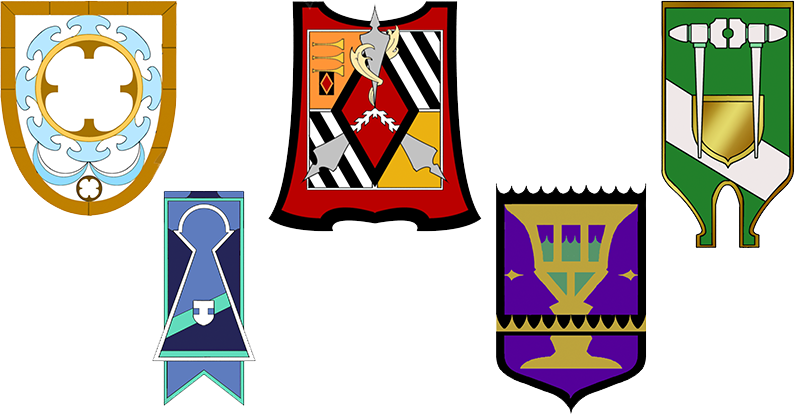
Heraldic Badges of the five courts, Ardenvale, Vantress, Embereth, Locthwain, and Garenbrig By WOTC

    As previously mentioned, the courts of Eldraine had their own unique values: Ardenvale's is loyalty, Vantress' is knowledge, Locthwain values persistence, Embereth holds courage in high esteem, and Garenbrig values strength. Based on their respective value, the courts offer challenges to participants in order for them to be recognized as a knight in that court. In fact, knights can be recognized by multiple courts, provided they beat the challenges, and in order to be in the running as the ruler of Eldraine, you have to be recognized by all five courts. This connects to the idea of chivalry from the Middle Ages. Knights of the Middle Ages strived to embody all the chivalrous qualities despite how challenging some qualities can be while the knights of Eldraine faced literal challenges in order to be recognized as embodying specific qualities. Another quality of the courts that makes them distinct from each other is their prized relic that their value comes from. These relics are remainders of the time when elves ruled Eldraine and a court losing their relic can cause turmoil. Essentially these relics are similar to the relics of the Middle Ages. While Middle Age relics were typically body parts or objects associated with saints, both them and the Eldraine relics are highly prized due to their magical properties and rarity.

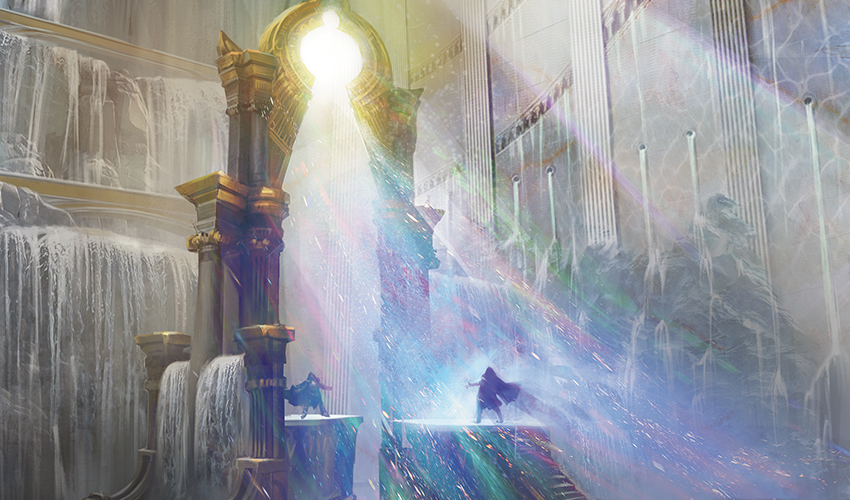
The Magic Mirror by Anatasia Ovchinnikova

Wilds of Eldraine

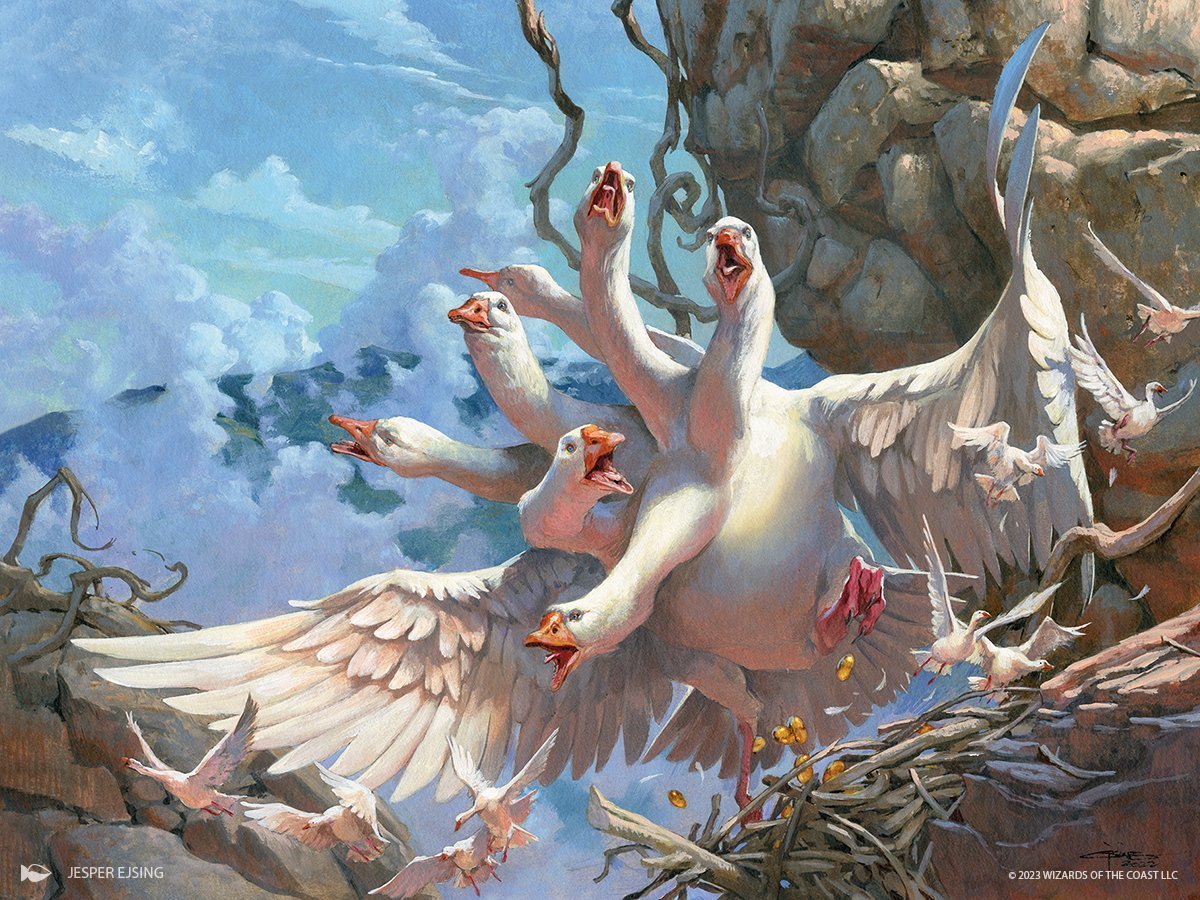
The Goose Mother by Jesper Ejsing
    When revisiting the realm of Eldraine, WOTC decided to take a closer look at what is referred to as the fair folk, a label for any sort of magical creature one may find exploring the wilderness. One of the more detailed examples were Eldraine's fae, magical faeries often sorted into courts of their own, with the most powerful being the residing lord or lady of their court. The types of fae also correspond with the various descriptions of fairies from the Middle Ages as the categories, based on behavior, are: benevolent, mildly inconvenient, and malevolent. Of course, other creatures from the Middle Ages make appearances in Eldraine too such as merfolk, dragons, and even unicorns. WOTC also made animals that would not look too far out of place from a medieval bestiary like The Goose Mother. While the name maybe be a pun about Mother Goose, the character is not some kindly old woman but rather a massive, flying goose hydra hybrid that fiercely defends its nest.

Works Cited

Ejsing, Jesper. "The Goose Mother." Magic: The Gathering, Wizards of the Coast, 2023, scg-       static.starcitygames.com/articles/2023/08/819129e)-the-goose-mother.jpg. Accessed 4            December 2024.
Finnegan, Jubilee. "A First Look at Wilds of Eldraine." Magic: The Gathering, Wizards of the     Coast, 2023, magic.wizards.com/en/news/announcements/a-first-look-at-wilds-of-                    eldraine. Accessed 4 December 2024.
"Heraldic Badges of Eldraine Courts." Magic: The Gathering, Wizards of the Coast, 2019,             media.wizards.com/2019/images/daily/qaMbGDAVb6.png. Accessed 4 December 2024.
Mooney, Chris. "Planeswalker's Guide to Eldraine." Magic: The Gathering, Wizards of the            Coast, 2019, magic.wizards.com/en/news/feature/planeswalkers-guide-eldraine-2019-10-       31. Accessed 4 December 2024.
Ovchinnikova, Anatasia. "The Magic Mirror." Magic: The Gathering, Wizards of the Coast,           2023, media.wizards.com/2019/images/daily/cardart-eld-TheMagicMirror.jpg. Accessed 4     December 2024.


Shrek - An Ogre's Medieval Roots

Fig.1 "Shrek talking to Donkey."


Summary:

The film, Shrek, is one that almost everyone has watched, or at least, has heard of. Shrek, an Ogre, is forced to travel to a far off land in order to protect the beloved swamp in which he inhabits, as it has been invaded by innumerable, infamous fairytale characters following their exile. His journey takes him on a quest to save a princess from a formidable dragon in order to deliver her to the suitor, Lord Farquaad, the man capable of protecting Shrek's swamp. The film is riddled with aspects of the medieval world, ranging from the setting to the fantastical characters, which makes it a profoundly inviting film to analyze. 

Setting:

Fig. 2 "Shrek's swamp."


The first aspect of Medievalism that comes through this movie manifests itself through the different settings and landscapes. We are first introduced to Shrek's swamp, with its fog, dense trees, and  murky water, it is a clear nod to the dark forests so often found  within medieval literature. Shrek himself, living here, can be connected to the medieval idea that trepidatious, daunting creatures live in these forests. 


This environment is then juxtaposed with Duloc, the kingdom ruled by Lord Farquaad. 
With the castle, the stone walls, and the stone town within the kingdom 
Fig. 3 "Duloc's knights and kingdom."
reflecting common medieval, gothic structures during the Middle Ages. There are also banners throughout the kingdom that displayed Lord Farquaad's power and superiority, another common part of castle and kingdoms in the Middle Ages. This goes hand in hand with the armor and weaponry present throughout the kingdom. Lastly, the tall, protected tower that Shrek's rescues Fiona from is a direct link to the damsel in distress trope of the Medieval period. 


Adventure Story and Fantasy Elements:

Arguably one of the most apparent aspects of the Medieval period is the idea of a quest. These quests test the knight and work to prove their status and worthiness. Throughout the film, Shrek embarks on a quest to save his Swamp, and in the process, must go on the truly medieval mission of saving the princess from the tower and the dragon that protects it. Interestingly, though, this connection also strays, as Shrek is an Ogre, not a knight. He also has no concern for his status, but only wishes to save his own interests. In this way, the film incorporates Medieval themes and ideas, but challenges them at the same time. 

Another interesting thing to note is the idea of exile in the film. Through extensive research into the Medieval genre of Old English Elegies, it has become clear that exile is one of the most prominent themes of the time, one that often acts as a catalyst. That is precisely what happens in the film, as the fairytale character's exile leads Shrek to leave his swamp and continue on the journey.

There is also the concept of talking animals in the film and Medieval literature. Innumerable works from the Middle Ages either feature, or even revolve around, animals that can talk. Donkey is simply named after the animal he represents, just as the owl and the nightingale are in the Medieval debate poem, "The Owl and the Nightingale,"which we read earlier this semester. 


Works Cited:

"Duloc's knights and kingdom." WikiShrek. Accessed 4 December 2024. https://shrek.fandom.com/wiki/Duloc_Knights

"Shrek's swamp." Airbnb Newsroom. Accessed 4 December 2024. https://news.airbnb.com/spend-the-night-in-shreks-swamp-now-on-airbnb/

"Shrek talking to Donkey." Siff. Accessed 4 December 2024. https://www.siff.net/programs-and-events/shrek-week/shrek


Tuesday, December 3, 2024

Sleeping Beauty - A Taste of Medievalism


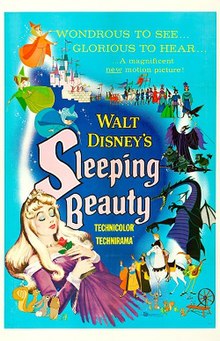
Sleeping Beauty (1959) (1) Film Poster

 The tale of Sleeping Beauty is one for the ages. A young girl pricks her finger on a spindle and falls asleep for 100 years only to be awakened by true love's kiss - a common theme in many fairy tales. This curse was placed upon Aurora as Maleficent's revenge for not getting invited into her royal christening. Sleeping Beauty (1) is just one of many fairy tales that have been adapted from the medieval world through the portrayal of the royal family and castles and their references to an iconic medieval trope - courtly love. 

References of Courtly Love.

First and foremost, this fairy tale takes place in the 14th century - prime medieval times - spanning from the 5th to 14th century. Not only when it takes place, but the setting as well - France, makes this fairy tale medieval. Throughout the fairy tale, there is a reference to courtly love. According to Bell Shakespeare, courtly love was a concept that "followed strict rules, combined with code of chivalry, and allowed knights and ladies to show their admiration for another regardless of their marital state" (Bell Shakespeare). Also going on to detail how during medieval times, this was seen as an act of nobility - especially among royals like knights or princes, which explains a lot of the interactions between Aurora and Prince Phillip. When they meet in the forest is another encountering theme in this type of literature, and it is alluded again to when King Stefan is trying to find a worthy man for his daughter in order to awake Aurora from her slumber. Finally, the act of courtly love is displayed when Prince Phillip slays Maleficent when she turns into a dragon - in hopes of saving Aurora. 

The Portrayal of the Royal Family and Castles.   


Sleeping Beauty (1959) Castle Interior. (2).

Secondly, a medieval aspect within Sleeping Beauty are of course the castles and the royal family. The castle is very Gothic in its architecture, much to the dismay of royal habitats of this time period. The castle shown in the picture has Gothic architecture due to its pillars, spires, and arched top windows called Lancet windows (2). Grand and divine was practically a prerequisite for them. One thing that makes this castle different from the rest of the Disney castles is the different blend of eras - besides Gothic, you can see bits of the Renaissance and Scandinavian periods in the way of design choices with elaborate pops of color. This castle was inspired by the Neuschwanstein Castle in Germany. Neuschwanstein itself was modeled after the medieval times with its towers and grand halls, but it was not built until the 18th century. This portion also highlights the fashion worn by the royal family. For example, in the beginning of the fairy tale, we see people coming to bless the new princess. Grateful to have her after struggles of infertility, there are women that come in wearing a cone shaped hat called a hennin. (3). Also, in medieval times, colors were separated by status, and were extremely important.

Different color Hennins' worn
in Sleeping Beauty (1959) (3). 
A breakdown of color status in Sleeping Beauty:

  • Black - Worn by Maleficent - represents evil
  • Royal Blue - worn by Aurora and other royals - represent royalty.
  • Pink - also worn by Aurora - represents warmth.
Also, some of the fairies have different colors that symbolize their character and gifts christened to baby Aurora (4).

  • Green - worn by Fauna - song.


  • Red - worn by Flora - beauty.         
  • Blue - worn by Merryweather - happiness.

                                                                                                 
Flora, Fauna, and Merryweather (4) in Sleeping Beauty (1959).
My Discoveries.   
Through my findings, I have discovered the theme of courtly love in many fairy tales - I truly had no idea how many there were. Especially for me, since it has been so long since I looked into a topic like this, it was interesting to do it again with a much older perspective. I found out there is a Sleeping Beauty Ballet, which as a dancer, I found it incredible and would love to see it someday! Also, while looking into the architecture, I discovered that some of the art was based on The Book of Hours - which was a prayer book depicting artworks of Christ, Mother Mary and other biblical figures. As well as the one of the Unicorn tapestries located in the Metropolitan Museum of Art Cloisters, visited by layout artist John Hinges in 1950 - he loved the artwork so much he wanted to emulate it in a future film, which happened to be 1959's Sleeping Beauty we all know and love.


Works Cited 


(4) "Art of Films: Waking Up Sleeping Beauty" Wordpress.com. 25 June 2012. https://filmgeekwatching.wordpress.com/2012/06/25/sleepingbeauty/

(3) Ingram, Anna. "How Disney's Sleeping Beauty Was Inspired by Late Medieval Tapestry" Daily Art Magazine.  2 December 2023. https://www.dailyartmagazine.com/sleeping-beauty-medieval-tapestry/


(2) Jo, Sophie. "Once Upon a Dream: The History of Sleeping Beauty Castle" Walt Disney. 19 December 2018. https://www.waltdisney.org/sleeping-beauty-castle


The Golden Years: Medievalism in A Knight's Tale

Original Theater Poster      The 2001 movie A Knight's Tale written, directed, and produced by Brian Helgeland is considered an action ...